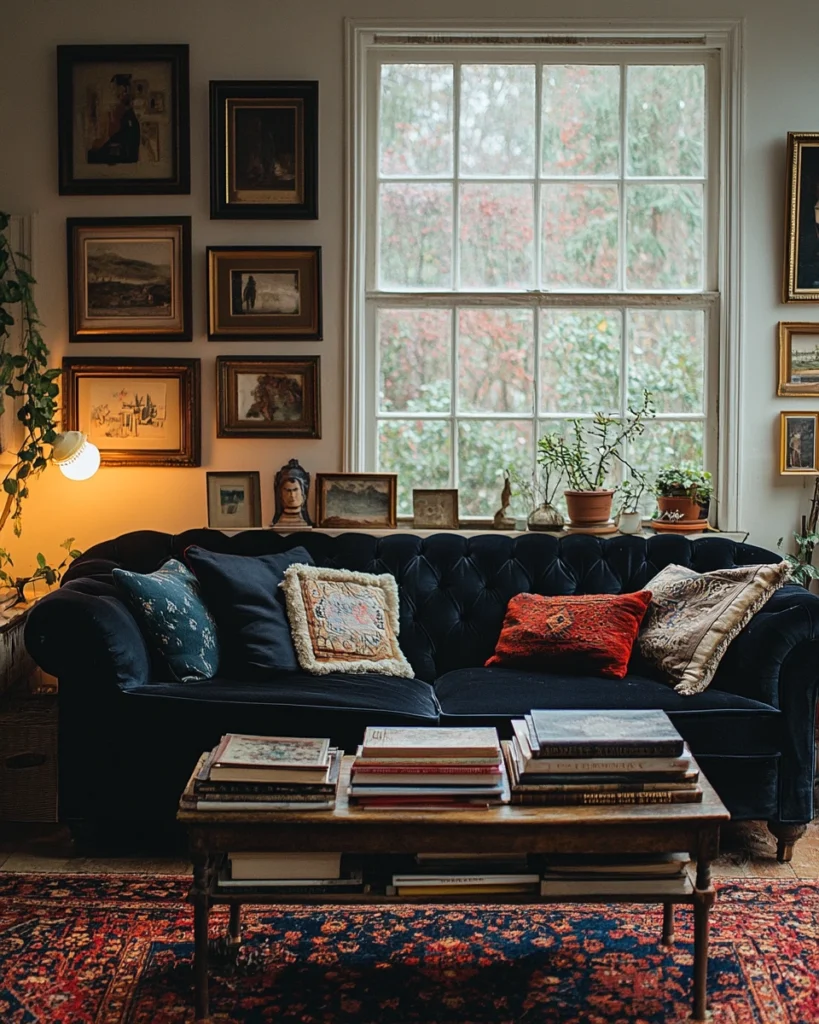
There’s something magnetic about a living room that doesn’t follow the rules — one where a brass art deco lamp sits beside a chunky mid-century sofa, and a faded Persian rug grounds it all. That’s the essence of the vintage eclectic style: deliberate mixing of different time periods, textures, and personalities into one cohesive, deeply personal space.
If done well, it looks curated and rich. If done poorly, it looks like a storage unit. This guide walks you through how to nail the balance.
What “Vintage Eclectic” Actually Means
Eclectic design is not “throw everything in a room and hope for the best.” It’s intentional contrast — pairing items from different decades so each piece gets to shine while contributing to a larger story.
Vintage eclectic specifically draws from real historical pieces or high-quality reproductions. Think 1920s Art Deco silhouettes alongside 1970s earth-tone upholstery, or Victorian carved wood frames holding abstract modern prints.
The goal is visual tension that still feels harmonious.
Start With One Strong Anchor Piece
Every successful eclectic room begins with one hero item — something bold enough to set the tone for the entire space.
This could be:
- A camelback sofa in aged velvet
- A 1960s curved credenza in walnut
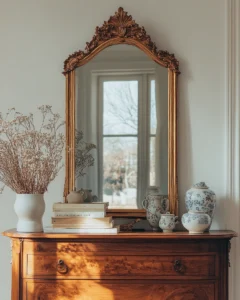
- An oversized gilded mirror with an ornate carved frame
- A worn kilim or Persian rug with jewel tones
Once you have your anchor, every other piece you add should respond to it — either echoing its color, material, or era, or providing deliberate contrast that makes both items look better.
How to Mix Furniture From Different Eras
This is where most people freeze. The trick is to mix by visual weight, not by style.
Match Scale, Not Style
A heavy Victorian armchair can sit beside a sleek Bauhaus side table as long as both feel like they belong in the same physical “weight class.” Pair chunky with chunky, slim with slim — just not from the same decade.
Use a Maximum of Three Eras
Going too wide historically makes a room feel chaotic. A focused eclectic room typically pulls from two or three distinct periods:
- Art Deco (1920s–30s) + Mid-Century Modern (1950s–60s) + Boho Global (1970s–80s)
- Victorian (late 1800s) + Industrial (early 1900s) + Retro Pop (1960s)
Repeat Materials to Create Cohesion
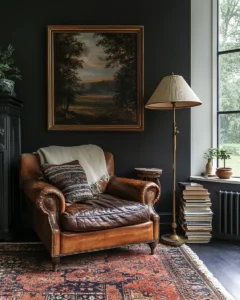
Even when styles clash, repeating a material ties everything together. If your anchor sofa has brass legs, bring in brass through a floor lamp, picture frames, or drawer pulls. The material becomes the thread.
Color Strategy for Vintage Eclectic Rooms
Color is your stabilizer. Without a thoughtful color palette, the mixing of styles tips into chaos.
Ground It With a Dark or Rich Base
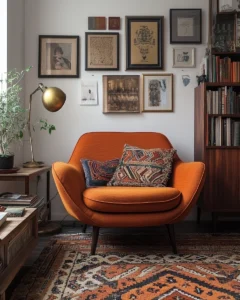
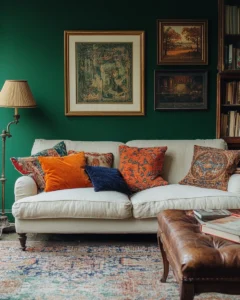
Vintage eclectic rooms almost always feature a strong base color — deep forest green, navy blue, terracotta, burgundy, or charcoal. This base prevents the mismatched furniture from looking like it floated in randomly.
Paint one wall, choose a sofa in this tone, or use a large rug as the color anchor.
Layer In Warm Neutrals
Warm cream, aged linen, and tobacco brown act as breathing room between the bold pieces. They let your eye rest between the statement items.
Add Color Through Textiles and Art
Throw pillows, framed artwork, and woven textiles are the safest place to introduce unexpected color pops — a cobalt blue lumbar pillow against a rust velvet sofa, or a bright abstract painting on a dark-painted wall.
Layering Textures the Right Way
In eclectic rooms, texture does as much work as color. The visual richness you see in well-styled vintage rooms comes from layering:
- Velvet against aged leather
- Rough linen against smooth lacquer
- Woven wool rugs layered over hardwood floors
- Hammered brass beside distressed wood
Use Rugs as the Foundation
A layered rug situation — a large flatweave underneath a smaller, patterned kilim or antique Persian — immediately communicates “eclectic done right.” It grounds the room and adds visual complexity at floor level before you even look at the furniture.
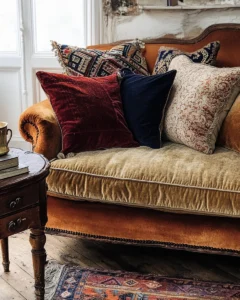
Mix Pillow Fabrics Deliberately
Don’t match your throw pillows. On a single sofa, combine a velvet pillow, a tapestry pillow, and a rough linen one. Different textures, same general color family — this is the eclectic formula applied at small scale.
Walls and Art in a Vintage Eclectic Room
Go Gallery Wall — But Make It Intentional
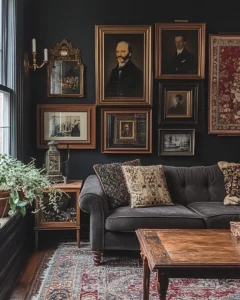
Gallery walls are the natural home of eclectic style, but the best ones have a unifying logic even when the frames differ. Options:
- Same frame finish, different artwork styles (all gold frames, mixing oil portraits with abstract prints)
- Same artwork style, different frame sizes (all vintage botanical illustrations, wildly varied frame shapes)
- Consistent color palette across all pieces, regardless of frame or subject
Mix Art Mediums
Oil paintings, vintage photography, textile art, architectural drawings, and mirrors — mixing mediums on a single wall creates the depth that makes eclectic rooms feel collected over decades, not assembled in a weekend.
Small Details That Elevate the Whole Room
The difference between an eclectic room that looks intentional and one that looks messy is often in the details:
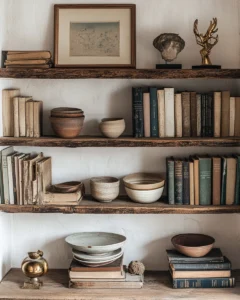
- Stack vintage books — spine-out with interesting titles visible — on coffee tables, side tables, and shelves
- Use hardware as jewelry — brass bin pulls, ceramic drawer knobs, and vintage hinges on any furniture piece elevate the whole look
- Collect ceramics with personality — sculptural bowls, chunky pottery mugs, and hand-thrown vases in earthy glazes add life to shelves and tabletops without needing to match
- Layer lighting — combine an overhead fixture with table lamps and a floor lamp so the room has warm, multi-source light rather than one flat overhead wash
Common Mistakes to Avoid
Even experienced decorators make these missteps in eclectic rooms:
- Too many focal points — if everything is screaming for attention, nothing gets it. Let your anchor piece lead.
- Ignoring scale — a room full of small items feels cluttered; one or two large-scale pieces give the eye somewhere to land.
- No color thread — picking pieces you love individually without checking if they share even one color will make the room feel like a thrift store.
- Buying everything at once — the best eclectic rooms are built slowly. Give yourself permission to leave a corner empty while you wait for the right piece.
Bringing It All Together
A vintage eclectic living room is ultimately a portrait of the person who lives in it — layered, curious, and unwilling to be defined by a single era or trend. The rules are there as scaffolding, not as a cage.
Start with one piece you genuinely love. Build outward from it, keeping color cohesion and material repetition as your anchors. Layer textures. Mix art. Leave room for future finds.
Done right, a vintage eclectic room never feels finished — and that’s exactly the point.
